
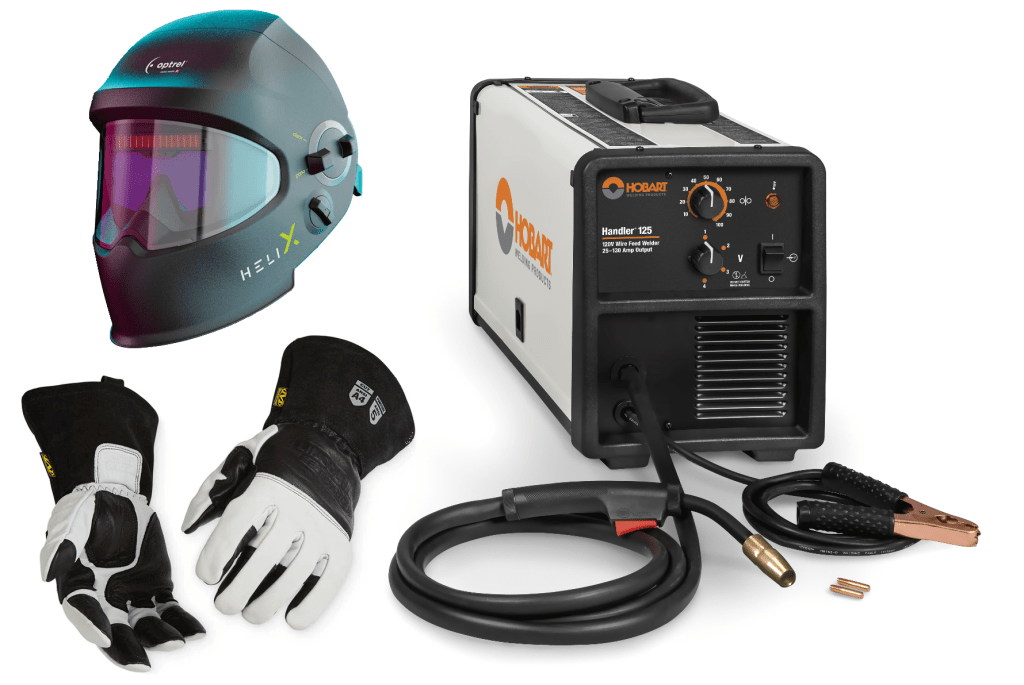
With MIG welding, you might have a bit more freedom in not being confined to a dedicated space. MIG welding some body panels might mean you’re outside and just need to way to stay cool from the sun or maybe a fire blanket to keep certain areas of the car from being exposed to sparks. In this case, your shop space might become more of a base to gather tools and collect your thoughts before you climb inside your car or even step out into your driveway to MIG something together. You’ll need a way to clip your welding wire, clean off the torch nozzle, and, most importantly, protect yourself from welding spatter, so consider this list of must-haves for your MIG welding journey:
Safety
Welding Mask/Helmet: This is probably THE single, most important piece of equipment you’ll use when welding. Not only does it keep your face protected from weld spatter, the lenses will keep you from destroying your vision (or worse, going completely blind!) and for this reason it’s not worth cheaping out on this purchasing – save the money elsewhere if needed, but invest in your safety here. If you prefer a “one shade” option, you can go with a passive helmet, but if you plan to do other forms of welding or even grinding/cutting, an auto-darkening helmet is worth the additional cost.
- Passive Helmet – Passive helmets come with single-shade lenses, so they are not able to be adjusted higher or lower in darkness. These are good options if you are on a tighter budget and/or you are always welding within a small amperage range. Most hobby welding will be done in the Shade 10 range, so a good choice here is the Miller MP-10 Passive Shade 10 Welding Helmet which costs about $50.
- Auto-Darkening – you can go pretty crazy here with pricing, but generally more expensive helmets mean a wider field of vision, quicker reacting/higher number of auto-darkening sensors, additional shade options, and better overall comfort. Helmet options here include:
- Entry-Level : Miller Welding Helmet – Black Classic (~$125)
- Mid-Range: ESAB Sentinel A60 Welding Helmet (~$370)
- High-End: Optrel Helix Quattro Welding Helmet ($575)
MIG Welding Gloves: MIG gloves will slightly differ from a set of TIG gloves in that they are made of thicker materials and generally have cuffs that offer more wrist/forearm protection. While the trade off with a thinner TIG glove means you may not get the same feeling through a thicker glove, you’ll often not need it in MIG welding since you aren’t having to precisely push filler rod into the weld as you do with TIG welding. As a bonus, MIG gloves are great protection for putting logs on a fire pit!
- Entry-Level: Chicago Electric Premium Welding Gloves (<$10)
- Mid-Range: Tillman Grain/Split Cowhide MIG Glove (~$25)
- High-End: Miller Cut-Resistant MIG Welding Gloves (~$45)
Head Covering: throw a bandana, or some other cotton head covering, on before your welding mask to protect your hair/top of your head. Nothing stings (or smells) like a wild bit of hot welding slag sitting on your noggin. As with any clothing in welding, it’s very important that this head covering is NOT made of a hybrid material that will melt instead of burn. In a worst case scenario, a burning cotton bandana will be easier to deal with than melted synthetic materials on your skin.
- Bandana: 2-Pack 100% Cotton Bandanas ($10-15)
- Welding Cap: Kromer Signature Welding Cap ($10-15)
Welding Blanket / Welding Mat: often made of materials like fiberglass, welding blankets are a good way to protect anything, that is in proximity to your welding area, from getting burned. While they aren’t crucial, these are nice to have when you are wedling in and around a car and need something to cover up something like a windshield.
Tools
MIG Pliers: this is a must for anyone using a MIG welder. In addition to being able to grip like any other set of pliers, MIG pliers offer you a way to clip your welding wire, scrape slag out of the MIG gun nozzle, and grip the contact tips for removal/replacement.
- Entry-Level: Berger 8 in. MIG Welding Pliers (~$15)
- High-End: Strong Hand Tools PM25 MIG Pliers ($30)
Copper Backers: this is more of a general type of item, but the idea here is to have copper material (small plates, blocks, etc.) that you can place against the backside of your welds to protect them from contamination and prevent blowing through. Copper has high thermal conductivity, so it takes more effort to heat up and thus it can pull heat away from your welding area more quickly and won’t melt into your welded area. These copper backer plates are placed on the back of your welding area temporarily and removed once finished.
- Various sizes of Multipurpose Copper Sheets/Bars (~$15-50)
Welder Cart: if you’ll need to move your welder around, as is common in welding roll cages, it’s worth investing into a welding cart to be able to move your welding machine and gas tank around more easily. Having to move these items around independently can get old quickly.
- Entry-Level: Chicago Electric 100 lb. Capacity Welding Cart (~$35)
- Mid-Range: Eastwood MIG/TIG/Plasma Welding Cart (~$130)
- High-End: Klutch Heavy-Duty Welding Workstation (~$350)
Consumables
Welding Wire: It helps to have various diameters/materials of welding wire at your fingertips as well as the accompanying MIG gun contact tips depending on what you’re welding. While these different wires will vary based on your material type, thickness, etc., a good starting point for hobby automotive welders would be .030″ diameter welding wire in either E71T-11 (used without gas shielding) or ER70S-6 (used with gas shielding).
- No Gas Required: Hobart E71T-11 .030 Flux-Cored Welding Wire
- Gas Shielding: Lincoln SuperArc L-56 ER70S-6 MIG Welding Wire
Contact Tips: Contact tips will need to match the size of wire you’ll be using for your project. To find the right contact tips, look for your specific MIG brand or MIG gun “series” then find the contact tip diameter that matches the wire you’ll be using (Hobart “H” Series gun and .030″ for example)
- Replacement Contact Tips: Cyberweld Replacement MIG Gun Parts
Welding Gas: Gas may or may not be necessary depending on your project needs and wire used, though MIG welding with gas often makes the process more comfortable and predictable (see also: minimal spatter). To determine which gas to use, take a look at your welding wire specifications as it is often suggested by the manufacturer which gas to use with their product (for example: 100% CO2 or a 75% Argon / 25% CO2 mix – aka “C25”). Small welding supply companies often offer a gas cylinder exchange service as do larger chains, like Airgas. Either try the old “Welding gas near me” search in Google or find a local Airgas brand using their website’s Dealer Locator to find a place nearby to get gas. For your first tank of gas, be prepared to be a, usually small and one-time, core fee to “rent” a gas cylinder.
![[VIDEO] 3D Scanning a CrossKart](https://fabricatorsdomain.com/wp-content/uploads/2025/02/fs-sxms_airbox_thumbnail.png?w=1024)
 The Fabricator's Domain
Leave a comment